UniversalTimberSlab
Demonstrator

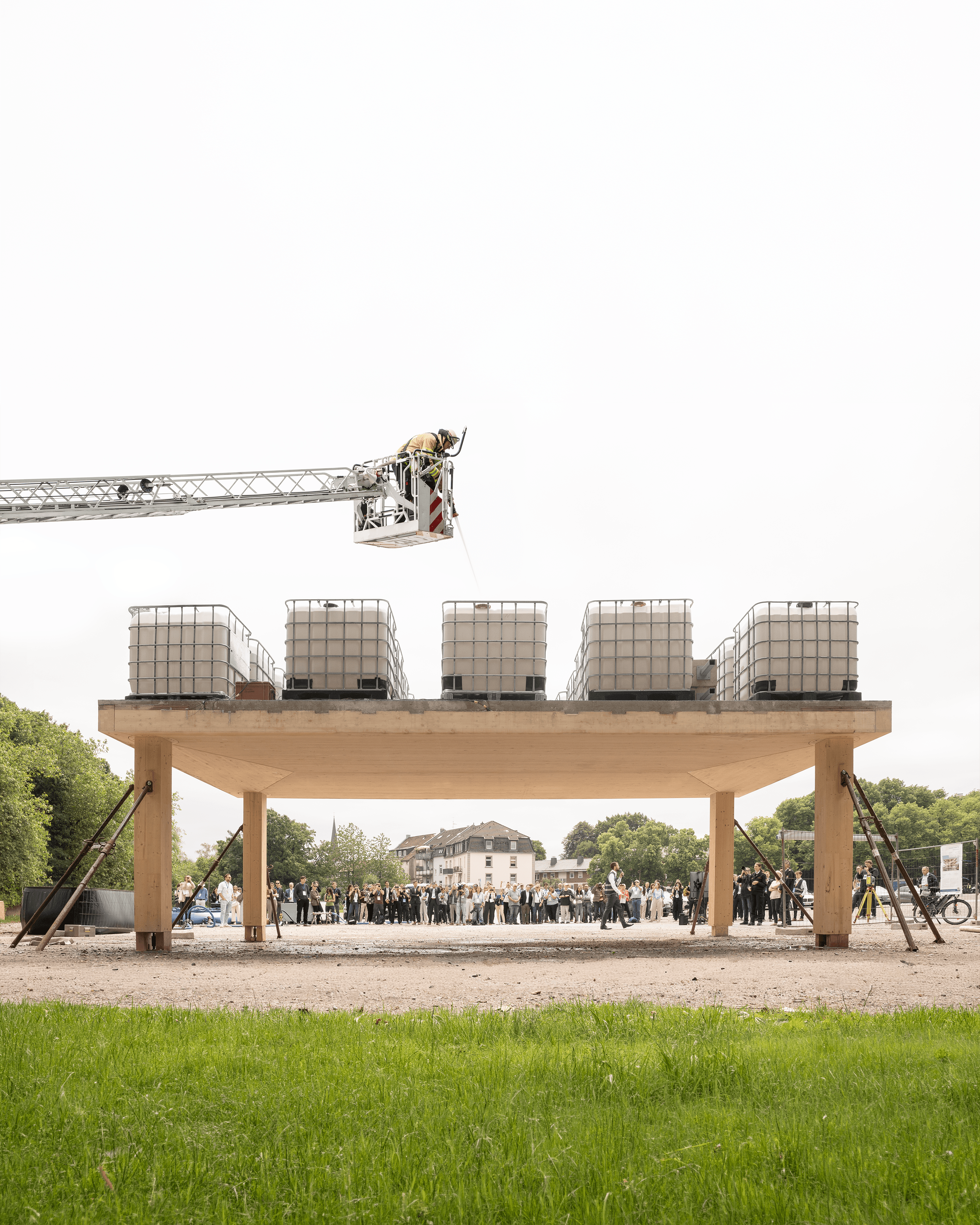
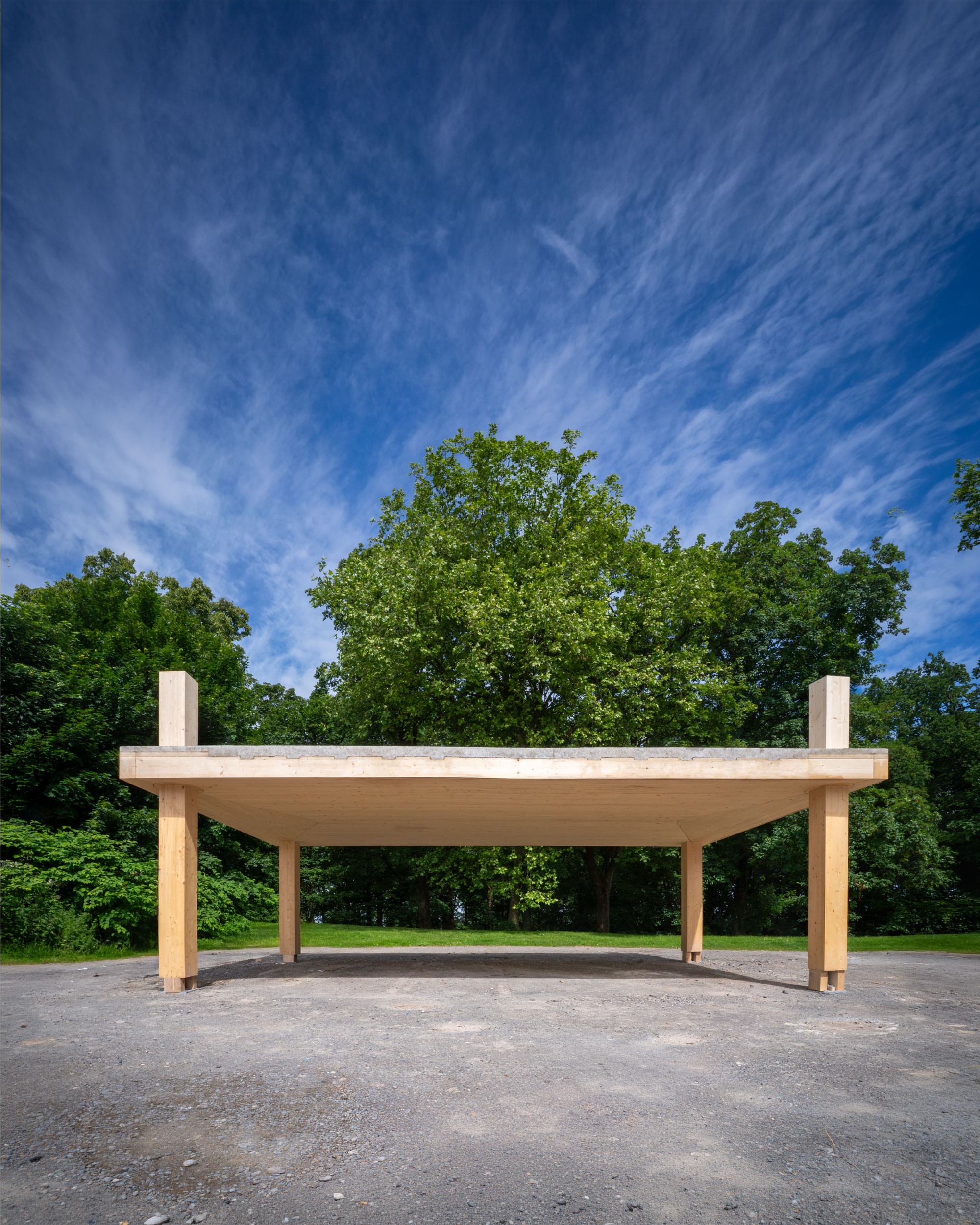
The UniversalTimberSlab demonstrator in Remscheid marks the world’s first successful construction of a point-supported, multi-axial long-span flat slab in timber–concrete composite construction. The underlying building system has been under development for the past eighteen months as part of the UniversalTimberSlab research project at the University of Stuttgart, funded by the European Innovation Council under Horizon Europe. For the client, Future Cleantech Architects, the system was realised at full scale for the first time within only three months, from the start of planning to completion. The demonstrator represents a single bay of the novel slab construction system. Measuring 9 × 5 metres and only 36 centimetres in height, it is as slender as a comparable reinforced-concrete flat slab while requiring approximately two-thirds less concrete.

Mit dem UniversalTimberSlab-Demonstrator in Remscheid konnte erstmals weltweit eine punktgestützte, mehrachsig weit spannende Flachdecke in Holz-Beton-Verbundbauweise gebaut und erfolgreich getestet werden. Das entsprechende Bausystem wird seit eineinhalb Jahren im Forschungsprojekt UniversalTimberSlab an der Universität Stuttgart entwickelt und vom European Innovation Council im Rahmen von Horizon Europe gefördert. Für den Bauherrn Future Cleantech Architects konnte das System innerhalb von nur drei Monaten – von Planungsbeginn bis zur Fertigstellung – erstmals im Maßstab 1:1 realisiert werden. Der Demonstrator bildet ein einzelnes Deckenfeld des neuartigen Geschossdeckensystems ab, misst 9 × 5 m und ist mit nur 36 cm so schlank wie eine vergleichbare Stahlbetondecke, benötigt dabei jedoch rund zwei Drittel weniger Stahlbeton.

Successful Validation in Full-Scale

In front of 200 visitors of the Future Cleantech Festival, the demonstrator was successfully tested with a load of 20 tonnes on top of its self-weight. This verified the structural capacity for a highly loaded office buildings with superimposed dead loads of 1.4 kN/m² and live loads of 3.0 kN/m². Measurements confirmed both the previously conducted finite-element simulations and the system’s high level of serviceability. The maximum measured deflection was only 12 millimetres, while the eigenfrequency exceeded 8 Hz.

The innovative floor segments were manufactured from glued-laminated-timber by the HASSLACHER Group and assembled by Dünschede Holzbau in just two days. The successful manufacture, assembly and experimental validation of the demonstrator represents several decisive milestones on the path towards widespread application of the UniversalTimberSlab in multi-storey timber construction.

Erfolgreiche Validierung
im Maßstab 1:1

Vor rund 200 Besucherinnen und Besuchern des Future Cleantech Festivals wurde der Demonstrator erfolgreich mit insgesamt 20 Tonnen zusätzlich zur Eigenlast belastet. Damit konnte die Tragfähigkeit für einen hoch beanspruchten Bürobau mit Ausbaulasten von 1,4 kN/m² und einer Nutzlast von 3,0 kN/m² nachgewiesen werden. Gleichzeitig bestätigten die Messungen mit einer maximalen Verformung von nur 12 mm sowie einer Eigenfrequenz von über 8 Hz die zuvor durchgeführten FEM-Simulationen und die hohe Gebrauchstauglichkeit des Systems.

Die innovativen Deckensegmente wurden von der HASSLACHER Gruppe aus Brettschichtholz gefertigt und von Dünschede Holzbau innerhalb von nur zwei Tagen montiert. Mit der erfolgreichen Fertigung, Montage und experimentellen Validierung wurden gleich mehrere entscheidende Meilensteine auf dem Weg zur breiten Anwendung des UniversalTimberSlab im mehrgeschossigen Holzbau erreicht.

Systemically Universal:
The UniversalTimberSlab

The UniversalTimberSlab transfers the potential of computational design methods to multi-storey timber construction. The system combines high structural performance through optimised fibre orientation with software-supported planning flexibility, enabling slender, economical and adaptable timber floor structures.

Timber construction offers enormous potential for sustainable and future-oriented building. However, current systems for multi-storey timber slabs often force designers to work within a narrow set of structural constraints. This results in both architectural design limitations, such as the need for regular structural grids, and economic and functional disadvantages. At present, these challenges can only be addressed economically through careful planning by timber-construction specialists and by restricting timber construction to fitting building typologies.

The systemic flexibility associated with reinforced-concrete flat slabs—with regard to spans, column positions and open floor-plan design—is not yet available to the same extent in timber–concrete composite floor systems. The UniversalTimberSlab brings this level of systemic flexibility to timber construction for the first time, providing a timber-based alternative to the reinforced-concrete flat slab.

The new technology enables slender, high-performance timber floor structures that can be applied across a wide range of building configurations without down stand beams. This allows building services to be routed freely beneath the slab and partition walls to be positioned with ease, substantially simplifying both the initial planning and the future adaptation of buildings.

The system is based on a patent-pending segmentation methodology that allows even complex and irregular slab geometries to be divided into glued-laminated-timber segments that can be prefabricated efficiently. At the same time, the fibre direction of each segment is optimised so that the structural capacity of timber is used as effectively as possible.

Systemisch universell:
Der UniversalTimberSlab

Der UniversalTimberSlab überträgt die Potenziale computerbasierter Entwurfsmethoden in den mehrgeschossigen Holzbau. Das System verbindet eine hohe Tragwerksleistung durch optimierte Faseranordnung mit softwaregestützter Planungsflexibilität und ermöglicht dadurch schlanke, wirtschaftliche und anpassungsfähige Holzgeschossdecken.

Der Holzbau bietet enormes Potenzial für nachhaltiges und zukunftsfähiges Bauen. Aktuelle Holzdeckensysteme für wirtschaftliche Geschossbauten zwingen Planende jedoch häufig in ein enges Korsett konstruktiver Randbedingungen. Daraus ergeben sich sowohl gestalterische Einschränkungen – etwa die Notwendigkeit regelmäßiger Gebäuderaster – als auch wirtschaftliche und funktionale Nachteile. Dazu zählen reduzierte Geschoßzahlen, geringere nutzbare Bruttogeschossflächen, eine aufwendige Führung der Gebäudetechnik unter der Decke sowie eine eingeschränkte Nutzungsflexibilität. Nur bei geeigneten Gebäudetypologien und mit sorgfältiger Planung durch Holzbauexperten lassen sich diese Herausforderungen in einem Holzgebäude wirtschaftlich bewältigen.

Grundlage hierfür ist eine zum Patent angemeldete Segmentierungsmethodik, mit der auch komplexe und unregelmäßige Deckengeometrien in einfach vorfertigbare Brettschichtholzsegmente unterteilt werden können. Gleichzeitig wird die Faserrichtung jedes Segments optimiert, sodass die Tragfähigkeit des Werkstoffs Holz bestmöglich ausgenutzt wird. Auf der Baustelle werden die Holzsegmente zunächst ohne direkte Verbindungen zueinander verlegt. Erst eine dünne, vor Ort eingebrachte Aufbetonschicht verbindet die Elemente zu einer leistungsfähigen Holz-Beton-Verbunddecke.

Die von Stahlbeton-Flachdecken bekannte systemische Flexibilität hinsichtlich Spannweiten, Auflager-Art und Position und Gebäuderaster steht im Holzbau derzeit noch nicht in vergleichbarer Weise zur Verfügung. Der UniversalTimberSlab überträgt diese Systemflexibilität erstmals auf den Holzbau. Die neue Technologie ermöglicht schlanke, leistungsfähige und systemisch universell einsetzbare Holzgeschossdecken und stellt damit eine holzbasierte Alternative zur Stahlbeton-Flachdecke dar.

UniversalTimberSlab Demonstrator
ICD Institute for Computational Design and Construction, University of Stuttgart
Prof. Achim Menges, Hans Jakob Wagner, Martin Alvarez, Juan David Frank Spinel, Tim Stark.
Supported by: Niels Töllner, Tommy-Lee Köpplin

ITKE Institute for Structural Design and Building Structures, University of Stuttgart
Prof. Dr.-Ing. Jan Knippers, Gregor Neubauer, Renan Prandini

Future Cleantech Architects, Remscheid
Dr. Peter Schniering, Johanna Rübcke, Friedrich Schubert, Leonie Brand

HASSLACHER Group
DI Georg Jeitler (HASSLACHER Holding GmbH, Sachsenburg)
Adrian Niehörster (HASSLACHER Holzbauteile GmbH & Co. KG, Kleinheubach)

Dünschede Holzbau GmbH, Arnsberg
Tobias Glaremin, Jörg, Dilbar, Philipp, Luca und Michel

UNIVERSALTIMBERSLAB RESEARCH TEAM

UNIVERSALTIMBERSLAB
FORSCHUNGSPARTNER

Institut für Computerbasiertes Entwerfen und Baufertigung (ICD), Universität Stuttgart
Martin Alvarez, Tim Stark, Max Zorn, Hans Jakob Wagner (PCoCo)
Prof. Dr.-Ing. Thomas Wortmann, Prof. Achim Menges

Institut für Tragkonstruktionen und Konstruktives Entwerfen (ITKE), Universität Stuttgart
Gregor Neubauer, Renan Prandini
Prof. Dr.-Ing. Jan Knippers

Institute Akustik und Bauphysik (IABP), Universität Stuttgart
Matthias Müller, Theresa Müller, Simon Panik, Julia Weißert
Prof. Dr.-Ing. Philip Leistner

Institute für Werkstoffe im Bauwesen (IWB), Universität Stuttgart
Materialprüfungsanstalt (MPA), Universität Stuttgart
Sabrin Machanek, Aaron Münzer, Dr.-Ing. Gerhard Dill-Langer
Prof. Dr. Philippe Grönquist

BUILT CoLAB, Porto
João Moutinho, Vanessa Tavares, Daniel Silva, Rita Mendonça, Luís Sanhudo

PROJECT SUPPORT

EIC - European Innovation Council and SMEs Executive Agency (EISMEA), Brussels
Franc Mouwen, Johannes Bunz, Carlos Casorrán Amilburu

IIGS - Institut für Ingenieursgeodäsie, Universität Stuttgart
Prof. Volker Schwieger, Laura Balange, Nasser Alhamad

ISYS – Institut für Systemdynamik, Universität Stuttgart
Prof. Oliver Sawodny, Sergey Klassen, Sven Hänzka, Eva Mendres

Reisser Schraubentechnik GmbH, Ingelfingen-Criesbach
Armin Bauer

Freiwillige Feuerwehr Remschei
Katharina Kluge, Sascha Ploch

Schützenverein Remscheid
Alexander Kreiker, Arnd zum Dome

Dirostahl GmbH, Remscheid
Dr. Roman Diederichs

EWR GmbH - Stadtwerke Remscheid Verbund
Mike Giera, Joachim Frings

Zimmerei Borge Oelbermann, Remscheid
Borge Oelbermann

PROJEKT FUNDING

EIC - European Innovation Council and SMEs Executive Agency (EISMEA)
Das Projekt UniversalTimeberSlab wurde im Rahmen des Forschungs- und Innovationsprogramms „Horizont Europa“ der Europäischen Union unter der Finanzhilfevereinbarung Nr. 101161103 gefördert.

EIC - European Innovation Council and SMEs Executive Agency (EISMEA)
Das Projekt UniversalTimeberSlab wurde im Rahmen des Forschungs- und Innovationsprogramms
„Horizont Europa“ der Europäischen Union unter der Finanzhilfevereinbarung Nr. 101161103 gefördert.

Contact

Coordinator: Hans Jakob Wagner, hans.jakob.wagner@icd.uni-stuttgart.de

The UniversalTimeberSlab project has received funding from the European Union’s Horizon Europe research and innovation programme under grant agreement No. 101161103.


Views and opinions expressed are however those of the author(s) only and do not necessarily reflect those of the European Union or the European Innovation Council (EIC). Neither the European Union nor the granting authority can be held responsible for them. Responsible person according to § 18 Section 2 State Treaty on the Media: Hans Jakob Wagner (University of Stuttgart). We are not willing nor obliged to participate in dispute resolution proceedings in front of a consumer arbitration board.


Copyright information: The content, texts and images on this website are subject to German copyright and ancillary copyright legislation. The reproduction, adaptation, distribution, and any kind of utilization outside the limits prescribed by copyright law require the written consent of the respective copyright owner. Permission is granted to download or print material published on this site for personal use only. Third-party copyright has been respected with regard to content on this website not created by the operator. In particular, content belonging to third parties is identified as such.

© All rights reserved. Patent pending.

Contact

Coordinator:

Hans Jakob Wagner hans.jakob.wagner@icd.uni-stuttgart.de

The UniversalTimeberSlab project has received funding from the European Union’s Horizon Europe research and innovation programme under grant agreement No. 101161103.


Views and opinions expressed are however those of the author(s) only and do not necessarily reflect those of the European Union or the European Innovation Council (EIC). Neither the European Union nor the granting authority can be held responsible for them. Responsible person according to § 18 Section 2 State Treaty on the Media: Hans Jakob Wagner (University of Stuttgart). We are not willing nor obliged to participate in dispute resolution proceedings in front of a consumer arbitration board.


Copyright information: The content, texts and images on this website are subject to German copyright and ancillary copyright legislation. The reproduction, adaptation, distribution, and any kind of utilization outside the limits prescribed by copyright law require the written consent of the respective copyright owner. Permission is granted to download or print material published on this site for personal use only. Third-party copyright has been respected with regard to content on this website not created by the operator. In particular, content belonging to third parties is identified as such.

© All rights reserved. Patent pending.

Contact

Coordinator: Hans Jakob Wagner, hans.jakob.wagner@icd.uni-stuttgart.de

The UniversalTimeberSlab project has received funding from the European Union’s Horizon Europe research and innovation programme under grant agreement No. 101161103.


Views and opinions expressed are however those of the author(s) only and do not necessarily reflect those of the European Union or the European Innovation Council (EIC). Neither the European Union nor the granting authority can be held responsible for them. Responsible person according to § 18 Section 2 State Treaty on the Media: Hans Jakob Wagner (University of Stuttgart). We are not willing nor obliged to participate in dispute resolution proceedings in front of a consumer arbitration board.


Copyright information: The content, texts and images on this website are subject to German copyright and ancillary copyright legislation. The reproduction, adaptation, distribution, and any kind of utilization outside the limits prescribed by copyright law require the written consent of the respective copyright owner. Permission is granted to download or print material published on this site for personal use only. Third-party copyright has been respected with regard to content on this website not created by the operator. In particular, content belonging to third parties is identified as such.

© All rights reserved. Patent pending.